How to Choose STR Insurance: What Your Policy Actually Covers
Feb 20, 2026
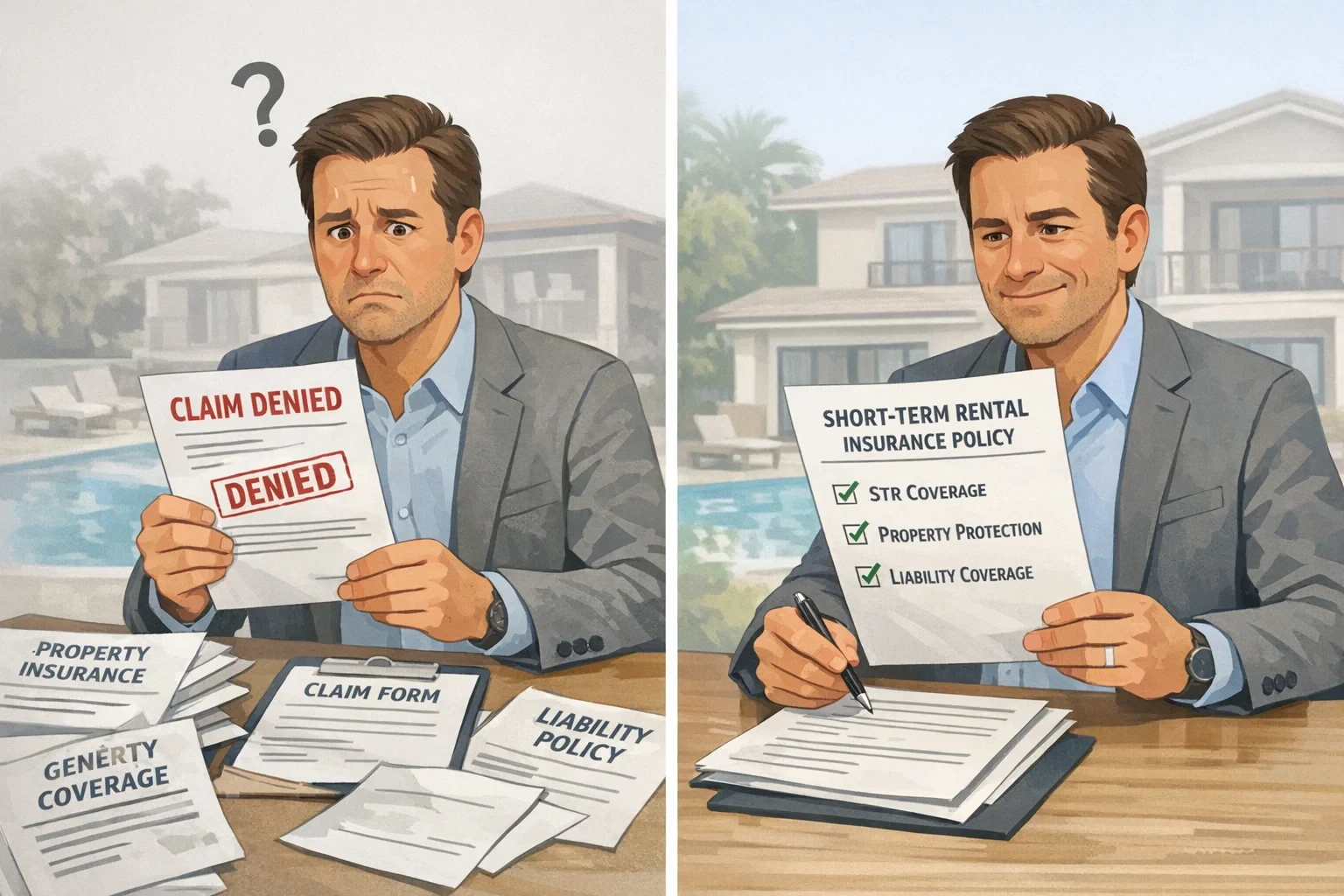
I've talked to a lot of property managers about claims. What insurance they have, how their last dispute went, whether they actually got paid. And the pattern I keep seeing is this: most people don't really understand what coverage they have until they need to use it.
By then it's too late.
This isn't a ranked list of insurance providers. It's more like... here's how to actually think about STR insurance so you can make an informed choice. Because the differences between policy types matter a lot more than most people realize.
Platform Protection Is Not Insurance
I'll keep this brief because we've covered it elsewhere, but this is the foundation of everything else.
Airbnb's Host Damage Protection is explicitly "not an insurance contract" according to their own terms. It's structured as a guarantee of the guest's obligation. Airbnb pays only if the guest doesn't. You have to pursue the guest first through the Resolution Center within 14 days of checkout.
Vrbo offers a $1M liability program, but it only covers third-party bodily injury and property damage during stays booked through their checkout system. It's not protecting your property.
Damage waivers that property managers charge guests? Also not insurance. Programs like iTrip's Home Guardian explicitly state they're "not insurance" and determinations are at the company's "sole discretion."
I wrote a whole breakdown of security deposits vs. damage waivers vs. platform protection if you want the full picture. The short version: these are backstops with significant limitations, not primary protection.
Actual insurance is a different product category entirely.
The Three Types of Coverage (And What Each Actually Means)
When you're shopping for coverage, you'll run into three general categories. Understanding the distinctions saves you from buying the wrong thing.
Standard Homeowners or Landlord Policies
This is what most people start with. If you own a property and have a mortgage, you probably have a homeowners policy. If you're renting it out long-term, you might have switched to a landlord (dwelling) policy.
Here's the problem: these policies almost universally exclude "business use" or "business pursuits." Running an STR is commercial activity. The moment your insurer realizes your property is being rented on Airbnb, your coverage can be rescinded.
A Pennsylvania legislative study from 2025 put it clearly: STRs are treated as a "commercial endeavor" and a basic homeowners policy may exclude home-based business activity.
This is probably the most expensive mistake in the industry. You think you're covered, you pay premiums for years, then you file a claim and it gets denied because you violated the policy terms by operating a business.
Home-Sharing Endorsements
Some traditional carriers now offer endorsements (add-ons) that extend your homeowners policy to cover short-term rental activity.
Travelers offers a "Home-Sharing Host Activities" endorsement that provides liability and property damage coverage during rentals. Pricing varies by total days rented per year.
Allstate has HostAdvantage, an add-on for host personal property damage up to $10,000 per rental period.
State Farm has a Home Rental Endorsement (HO-2440) available in at least some states, based on regulatory filings.
These endorsements can work for occasional hosts or people who rent part-time. But they typically have limitations on days per year, coverage caps, and they still operate within the framework of a homeowners policy. If you're running a full-time STR operation, they're often not enough.
STR-Specific Commercial Policies
This is what serious operators usually need. These are commercial policies built specifically for short-term rental use from the ground up.
Proper Insurance positions itself as a replacement for your homeowners or landlord policy entirely. It's a commercial business policy covering building, contents, general liability, and lost business revenue. They're backed by Lloyd's of London and endorsed by Vrbo. They emphasize coverages that standard policies exclude: amenities liability, liquor liability, squatter protection, bed bug coverage, pet/animal liability.
CBIZ Vacation Rental Insurance launched a redesigned national program in 2025 backed by an A-rated carrier. Their program overview shows $1M per occurrence / $2M annual aggregate liability limits with options for umbrella and flood coverage.
Safely offers a pay-per-booking model where you only pay for nights you actually rent. This can make sense for properties with lower occupancy or seasonal rentals.
RentalGuardian through their Home Guardian+ program offers $1M liability, $1M real property, and $25,000 contents. They note it's "not intended to replace primary homeowners/GL" and is underwritten by Lloyd's and Markel.
The key difference with STR-specific policies: they're designed knowing your property will have paying strangers rotating through it constantly. The coverage terms account for that reality.
Exclusions That Actually Matter
Whatever policy you're considering, read the exclusions. This is where claims die.
"Care, Custody, and Control"
CBIZ's guide for STR owners calls out "care, custody, and control" exclusions as a common reason guest-caused damage gets denied under homeowners policies. If someone has temporary custody of property (like a guest staying in your rental), damage they cause might be excluded.
Business Pursuits Limitations
Even policies that offer business-related endorsements often have caps or carve-outs. An IRMI analysis discusses how homeowners endorsements might extend property coverage but still not fix the liability exclusion for business activities.
Intentional Acts and Parties
Most policies exclude intentional damage. If a guest throws a party that trashes your place, coverage might depend on whether the damage is classified as "vandalism" (potentially covered) or "intentional destruction" (potentially excluded). The language matters.
Amenity-Specific Exclusions
Pools, hot tubs, trampolines, watercraft... these often have their own exclusion language or require additional riders. If you have amenities, make sure they're actually covered.
How to Evaluate Providers
When you're comparing options, here's what to actually ask:
"Does this policy know I'm running an STR?" If you're adding an endorsement to a homeowners policy, make sure the base policy actually allows STR activity. Some endorsements cover the rental activity but the underlying policy still technically excludes business use. That's a problem.
"What's the claims process and timeline?" Safely's program documents specify claims must be submitted within 60 days with invoices or written estimates. Platform protection has different deadlines (Airbnb is 14 days). Know what you're signing up for.
"Who's the actual underwriter?" The company you buy from might not be the company backing the policy. Proper is backed by Lloyd's. RentalGuardian uses Lloyd's and Markel. CBIZ uses an A-rated carrier. The underwriter's financial stability matters if you need a large payout.
"What documentation do they require for claims?" This varies significantly. Some require professional estimates. Some require specific photo formats. Some send inspectors for claims over a threshold (Safely sends inspectors for claims likely to exceed $1,000). Knowing this upfront helps you prepare.
What Affects Your Premiums
STR insurance isn't cheap. Most estimates put single-family STR policies in the $1,500 to $3,500/year range, with luxury and beachfront properties running $2,500 to $4,000+.
Factors that drive premiums:
Property location: Coastal, wildfire-prone, and hurricane zones cost more. California FAIR Plan exposure rose 52% year-over-year as of September 2025.
Property value and replacement cost: Higher value = higher premiums.
Occupancy and rental frequency: Some policies (like Travelers' endorsement) price based on days rented per year. Pay-per-booking models like Safely scale with your actual usage.
Amenities: Pools, hot tubs, and other liability magnets increase costs.
Claims history: Prior claims on the property can affect rates.
Coverage limits you choose: Higher limits and lower deductibles cost more.
For context, the broader property insurance market is also getting more expensive. ICE Mortgage Monitor data showed average annual property insurance premiums rose 14% in 2024 alone, capping a 61% increase over five years.
State Requirements You Might Not Know About
Some states actually mandate STR insurance. This isn't comprehensive, but a few examples:
Massachusetts requires STR operators to carry at least $1,000,000 liability insurance
Arizona requires $500,000 liability aggregate or listing through a platform that provides equivalent coverage
Washington passed a law requiring $1M primary liability insurance for STR operators
Your local municipality might have additional requirements. Check before assuming you're compliant.
When to Reassess Your Coverage
Your insurance needs change as your portfolio grows. A few triggers that should prompt a review:
Adding properties: Each property might need its own coverage, or you might qualify for portfolio policies with better rates.
Crossing listing thresholds: Airbnb's Host Liability Insurance terms change if you have 6+ active listings. At that scale, HLI may become excess coverage that requires contribution from your other policies.
Increasing property values: If you've renovated or property values have risen significantly, your coverage limits might be inadequate.
Adding high-risk amenities: Installing a pool or hot tub? Your current policy might not cover the added liability.
Moving into new markets: Different states have different requirements and risk profiles.
The Documentation Connection
Here's the thing that ties all of this together: whatever insurance you choose, the claims process requires the same thing. Timestamped evidence. Before and after documentation. Proof that damage occurred during a specific guest's stay.
I wrote about how proper documentation affects your insurance claims separately. And we have detailed guides for why claims get denied and how to actually win disputes with Airbnb and Vrbo.
The short version: having good insurance is half the equation. Being able to prove your claim is the other half.
This is where RapidEye fits. We do automated baseline comparison that catches damage between stays and generates timestamped documentation. It works whether you're filing a platform dispute, a damage waiver claim, or an actual insurance claim. The evidence requirements are similar across all of them.
Good coverage + solid documentation = claims that actually get paid.
Quick Reference: Policy Types at a Glance
Policy Type | Best For | Typical Limits | Key Limitation |
|---|---|---|---|
Homeowners (no endorsement) | Not STR use | Varies | Excludes business activity |
Home-sharing endorsement | Part-time / occasional hosts | Often capped at $10K-50K damage | Days-per-year limits |
STR-specific commercial | Full-time operators | $1M+ liability common | Higher premiums |
Pay-per-booking (Safely, etc.) | Seasonal or variable occupancy | Varies by program | Coverage only when booked |
If you're relying solely on platform protection and damage waivers, you're probably underinsured. If you're running STR activity on a standard homeowners policy without disclosure, you might be uninsured entirely.
The fix isn't complicated. Get a policy that actually knows what you're doing with the property. Read the exclusions. Understand the claims process before you need it.
And document everything. That part never changes.
I've talked to a lot of property managers about claims. What insurance they have, how their last dispute went, whether they actually got paid. And the pattern I keep seeing is this: most people don't really understand what coverage they have until they need to use it.
By then it's too late.
This isn't a ranked list of insurance providers. It's more like... here's how to actually think about STR insurance so you can make an informed choice. Because the differences between policy types matter a lot more than most people realize.
Platform Protection Is Not Insurance
I'll keep this brief because we've covered it elsewhere, but this is the foundation of everything else.
Airbnb's Host Damage Protection is explicitly "not an insurance contract" according to their own terms. It's structured as a guarantee of the guest's obligation. Airbnb pays only if the guest doesn't. You have to pursue the guest first through the Resolution Center within 14 days of checkout.
Vrbo offers a $1M liability program, but it only covers third-party bodily injury and property damage during stays booked through their checkout system. It's not protecting your property.
Damage waivers that property managers charge guests? Also not insurance. Programs like iTrip's Home Guardian explicitly state they're "not insurance" and determinations are at the company's "sole discretion."
I wrote a whole breakdown of security deposits vs. damage waivers vs. platform protection if you want the full picture. The short version: these are backstops with significant limitations, not primary protection.
Actual insurance is a different product category entirely.
The Three Types of Coverage (And What Each Actually Means)
When you're shopping for coverage, you'll run into three general categories. Understanding the distinctions saves you from buying the wrong thing.
Standard Homeowners or Landlord Policies
This is what most people start with. If you own a property and have a mortgage, you probably have a homeowners policy. If you're renting it out long-term, you might have switched to a landlord (dwelling) policy.
Here's the problem: these policies almost universally exclude "business use" or "business pursuits." Running an STR is commercial activity. The moment your insurer realizes your property is being rented on Airbnb, your coverage can be rescinded.
A Pennsylvania legislative study from 2025 put it clearly: STRs are treated as a "commercial endeavor" and a basic homeowners policy may exclude home-based business activity.
This is probably the most expensive mistake in the industry. You think you're covered, you pay premiums for years, then you file a claim and it gets denied because you violated the policy terms by operating a business.
Home-Sharing Endorsements
Some traditional carriers now offer endorsements (add-ons) that extend your homeowners policy to cover short-term rental activity.
Travelers offers a "Home-Sharing Host Activities" endorsement that provides liability and property damage coverage during rentals. Pricing varies by total days rented per year.
Allstate has HostAdvantage, an add-on for host personal property damage up to $10,000 per rental period.
State Farm has a Home Rental Endorsement (HO-2440) available in at least some states, based on regulatory filings.
These endorsements can work for occasional hosts or people who rent part-time. But they typically have limitations on days per year, coverage caps, and they still operate within the framework of a homeowners policy. If you're running a full-time STR operation, they're often not enough.
STR-Specific Commercial Policies
This is what serious operators usually need. These are commercial policies built specifically for short-term rental use from the ground up.
Proper Insurance positions itself as a replacement for your homeowners or landlord policy entirely. It's a commercial business policy covering building, contents, general liability, and lost business revenue. They're backed by Lloyd's of London and endorsed by Vrbo. They emphasize coverages that standard policies exclude: amenities liability, liquor liability, squatter protection, bed bug coverage, pet/animal liability.
CBIZ Vacation Rental Insurance launched a redesigned national program in 2025 backed by an A-rated carrier. Their program overview shows $1M per occurrence / $2M annual aggregate liability limits with options for umbrella and flood coverage.
Safely offers a pay-per-booking model where you only pay for nights you actually rent. This can make sense for properties with lower occupancy or seasonal rentals.
RentalGuardian through their Home Guardian+ program offers $1M liability, $1M real property, and $25,000 contents. They note it's "not intended to replace primary homeowners/GL" and is underwritten by Lloyd's and Markel.
The key difference with STR-specific policies: they're designed knowing your property will have paying strangers rotating through it constantly. The coverage terms account for that reality.
Exclusions That Actually Matter
Whatever policy you're considering, read the exclusions. This is where claims die.
"Care, Custody, and Control"
CBIZ's guide for STR owners calls out "care, custody, and control" exclusions as a common reason guest-caused damage gets denied under homeowners policies. If someone has temporary custody of property (like a guest staying in your rental), damage they cause might be excluded.
Business Pursuits Limitations
Even policies that offer business-related endorsements often have caps or carve-outs. An IRMI analysis discusses how homeowners endorsements might extend property coverage but still not fix the liability exclusion for business activities.
Intentional Acts and Parties
Most policies exclude intentional damage. If a guest throws a party that trashes your place, coverage might depend on whether the damage is classified as "vandalism" (potentially covered) or "intentional destruction" (potentially excluded). The language matters.
Amenity-Specific Exclusions
Pools, hot tubs, trampolines, watercraft... these often have their own exclusion language or require additional riders. If you have amenities, make sure they're actually covered.
How to Evaluate Providers
When you're comparing options, here's what to actually ask:
"Does this policy know I'm running an STR?" If you're adding an endorsement to a homeowners policy, make sure the base policy actually allows STR activity. Some endorsements cover the rental activity but the underlying policy still technically excludes business use. That's a problem.
"What's the claims process and timeline?" Safely's program documents specify claims must be submitted within 60 days with invoices or written estimates. Platform protection has different deadlines (Airbnb is 14 days). Know what you're signing up for.
"Who's the actual underwriter?" The company you buy from might not be the company backing the policy. Proper is backed by Lloyd's. RentalGuardian uses Lloyd's and Markel. CBIZ uses an A-rated carrier. The underwriter's financial stability matters if you need a large payout.
"What documentation do they require for claims?" This varies significantly. Some require professional estimates. Some require specific photo formats. Some send inspectors for claims over a threshold (Safely sends inspectors for claims likely to exceed $1,000). Knowing this upfront helps you prepare.
What Affects Your Premiums
STR insurance isn't cheap. Most estimates put single-family STR policies in the $1,500 to $3,500/year range, with luxury and beachfront properties running $2,500 to $4,000+.
Factors that drive premiums:
Property location: Coastal, wildfire-prone, and hurricane zones cost more. California FAIR Plan exposure rose 52% year-over-year as of September 2025.
Property value and replacement cost: Higher value = higher premiums.
Occupancy and rental frequency: Some policies (like Travelers' endorsement) price based on days rented per year. Pay-per-booking models like Safely scale with your actual usage.
Amenities: Pools, hot tubs, and other liability magnets increase costs.
Claims history: Prior claims on the property can affect rates.
Coverage limits you choose: Higher limits and lower deductibles cost more.
For context, the broader property insurance market is also getting more expensive. ICE Mortgage Monitor data showed average annual property insurance premiums rose 14% in 2024 alone, capping a 61% increase over five years.
State Requirements You Might Not Know About
Some states actually mandate STR insurance. This isn't comprehensive, but a few examples:
Massachusetts requires STR operators to carry at least $1,000,000 liability insurance
Arizona requires $500,000 liability aggregate or listing through a platform that provides equivalent coverage
Washington passed a law requiring $1M primary liability insurance for STR operators
Your local municipality might have additional requirements. Check before assuming you're compliant.
When to Reassess Your Coverage
Your insurance needs change as your portfolio grows. A few triggers that should prompt a review:
Adding properties: Each property might need its own coverage, or you might qualify for portfolio policies with better rates.
Crossing listing thresholds: Airbnb's Host Liability Insurance terms change if you have 6+ active listings. At that scale, HLI may become excess coverage that requires contribution from your other policies.
Increasing property values: If you've renovated or property values have risen significantly, your coverage limits might be inadequate.
Adding high-risk amenities: Installing a pool or hot tub? Your current policy might not cover the added liability.
Moving into new markets: Different states have different requirements and risk profiles.
The Documentation Connection
Here's the thing that ties all of this together: whatever insurance you choose, the claims process requires the same thing. Timestamped evidence. Before and after documentation. Proof that damage occurred during a specific guest's stay.
I wrote about how proper documentation affects your insurance claims separately. And we have detailed guides for why claims get denied and how to actually win disputes with Airbnb and Vrbo.
The short version: having good insurance is half the equation. Being able to prove your claim is the other half.
This is where RapidEye fits. We do automated baseline comparison that catches damage between stays and generates timestamped documentation. It works whether you're filing a platform dispute, a damage waiver claim, or an actual insurance claim. The evidence requirements are similar across all of them.
Good coverage + solid documentation = claims that actually get paid.
Quick Reference: Policy Types at a Glance
Policy Type | Best For | Typical Limits | Key Limitation |
|---|---|---|---|
Homeowners (no endorsement) | Not STR use | Varies | Excludes business activity |
Home-sharing endorsement | Part-time / occasional hosts | Often capped at $10K-50K damage | Days-per-year limits |
STR-specific commercial | Full-time operators | $1M+ liability common | Higher premiums |
Pay-per-booking (Safely, etc.) | Seasonal or variable occupancy | Varies by program | Coverage only when booked |
If you're relying solely on platform protection and damage waivers, you're probably underinsured. If you're running STR activity on a standard homeowners policy without disclosure, you might be uninsured entirely.
The fix isn't complicated. Get a policy that actually knows what you're doing with the property. Read the exclusions. Understand the claims process before you need it.
And document everything. That part never changes.