Damage Detection for Luxury Short-Term Rentals: What's Different When Stakes Are Higher
Feb 12, 2026
Most property management content treats all vacation rentals the same. A beachfront cottage and a penthouse in Manhattan get the same advice about checklists and turnover procedures. But if you're managing luxury properties, you already know the challenges are fundamentally different.
We work with about 200 luxury homes in NYC right now. These aren't generic Airbnbs. They're properties where a single piece of furniture can cost more than a month's rent at a standard rental. The inspection problem at this tier isn't just about catching damage. It's about catching the right damage, proving it happened, and doing it at a scale that makes sense.
The Math Changes at the Luxury Tier
Here's what standard damage detection is built for: stained carpets, broken blinds, scratched countertops. Important stuff, but we're talking hundreds of dollars per incident. Research from Vivint puts the average damage expense from rule-breaking guests at around $553.
Now consider what's actually in a luxury rental:
Item | Replacement Cost |
|---|---|
$7,045 | |
$11,000 | |
$15,310 | |
$17,310+ | |
$650 |
A single damaged item can exceed the total annual damage costs at a standard property. And this is before we talk about artwork, curated accessories, or anything truly irreplaceable.
The luxury vacation rental market hit $26.5 billion in 2024 and is growing at 9.3% annually. Demand for properties priced above $1,000 per night rose 15% last year compared to just 6% for everything below that threshold. More luxury inventory means more high-value items at risk.
Documentation Requirements Are Actually Different
This isn't just about the money. It's about what you need to prove.
Airbnb's Host Damage Protection requires hosts to submit claims within 30 days with supporting documentation including:
Photographs and videos as evidence
Complete inventory of damaged or missing property
Make and model information
Original purchase or acquisition date
Condition at time of loss
Estimated repair or replacement cost with documentation
For a standard rental, this is annoying but manageable. For a luxury property with dozens of high-value items? This documentation burden is enormous unless you have systems built for it.
There's also the insurance angle. Luxury STR insurance runs $3,500 to $6,000+ annually. Insurance companies aren't just trusting your word when claims start hitting thousands of dollars. They want evidence. Timestamped, comprehensive evidence.
And with Airbnb's April 2024 ban on indoor security cameras, you can't rely on continuous monitoring anymore. Your inspection documentation is basically your only visual record of property condition.
The Staging Drift Problem
Here's something that doesn't get talked about enough: at the luxury tier, things don't just break. They get subtly wrong.
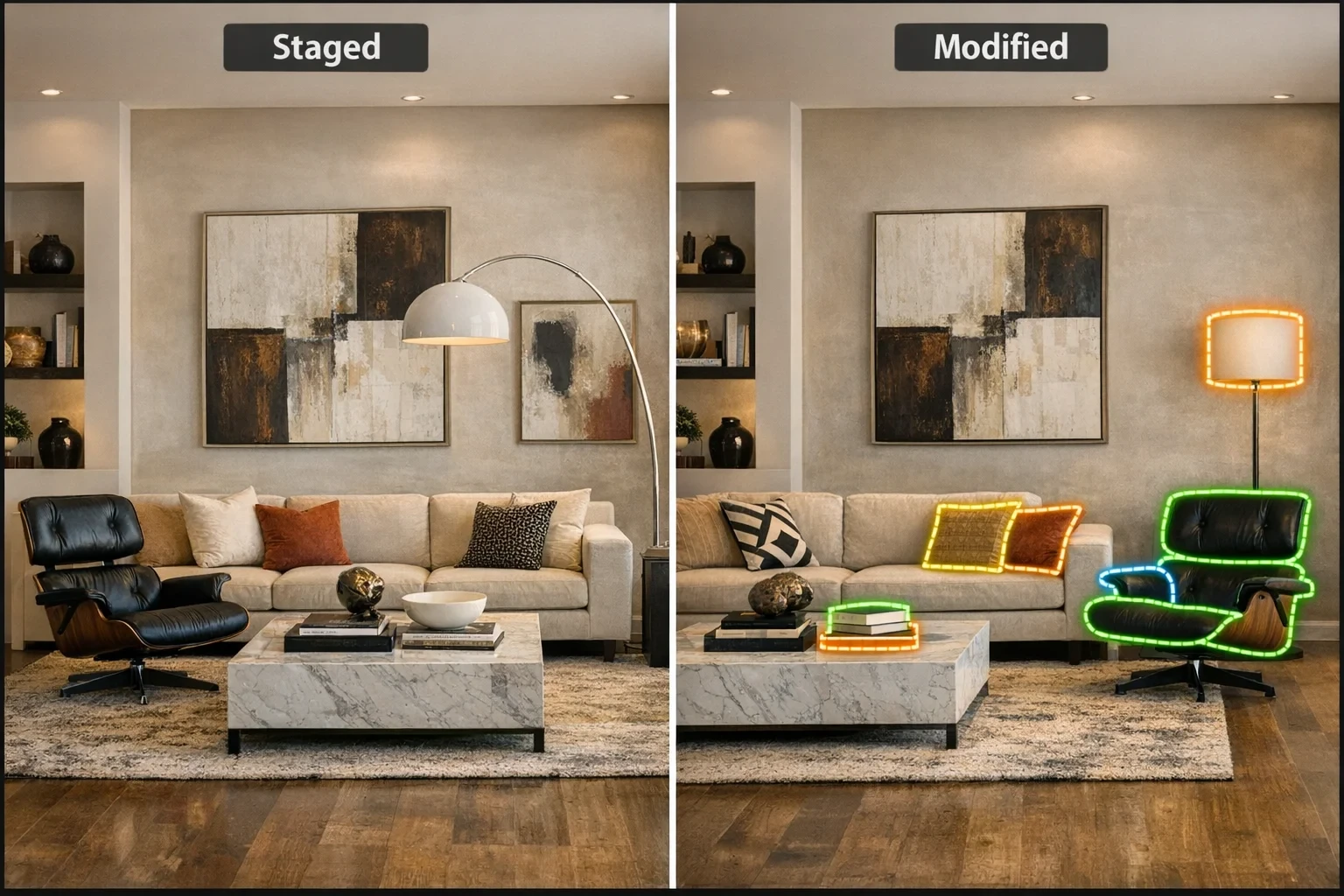
I call this staging drift. A guest moves a $7,000 chair to a different spot. Someone swaps the Frette sheets for something they brought from home and forgets to swap back. An accent piece ends up in a drawer. The wine glasses on the bar cart get rearranged.
None of this is "damage" in the traditional sense. But luxury guests are paying for a curated experience. They booked based on photos showing a specific aesthetic. When staging drifts, you get complaints. You get bad reviews. You get owners asking why their property doesn't look like the listing anymore.
Standard checklists don't catch this. A cleaner checking "living room complete" isn't comparing the current furniture arrangement against the original staging design. They're confirming the room is clean.
Why Baseline Comparison Actually Matters
This is where most inspection approaches fall short for luxury. They're built to confirm cleanliness, not to detect change.
Baseline comparison means having a detailed visual record of exactly how the property should look, then comparing current state against that baseline. Not just "is there damage?" but "is everything where it should be, in the condition it should be in?"
For a property with curated art, designer furniture, and intentional staging, you need:
Documentation of every item's position
Visual records of condition (not just presence)
The ability to spot when something gets replaced with a cheaper version
Automated comparison so you're not relying on memory
That last point matters a lot. One recent case made headlines when a £12,000 damage claim was disputed over allegedly manipulated images. When disputes get expensive, both sides start questioning the evidence. Having systematic, timestamped baseline comparisons makes your documentation defensible.
Video Walkthroughs as the Natural Fit
Static photos work fine for standard rentals. For luxury, video walkthroughs make more sense for a few reasons:
More comprehensive coverage. A video captures angles and details that discrete photos miss.
Harder to dispute. Continuous footage is more defensible than individual shots.
Shows context. How items relate to each other spatially matters when you're tracking staging.
Natural for the price point. Properties renting for $1,000+ per night justify the extra documentation effort.
The challenge is that video generates way more data than photos. Which brings us to the scaling problem.
The Scaling Problem at the Luxury Tier
Let's say you have 50 luxury properties turning over multiple times per week. Each turnover generates a video walkthrough. That's hundreds of hours of footage monthly.
No one is watching all of that. Manual review at scale is impossible. So either you accept that damage slips through, or you find a way to automate the review process.
This is what we built RapidEye for. Our system processes inspection videos and compares them against baseline records automatically. It flags changes, whether that's actual damage or staging drift or a missing item. Property managers get a report of what changed without having to watch hours of footage.
We've processed over a million photos for a single client already. The same technology works with video. The goal is making comprehensive documentation practical at scale, not just theoretically possible.
What This Means for Luxury Property Managers
If you're managing high-end rentals, the inspection approach that works for standard portfolios probably isn't enough. Higher-value items mean higher documentation requirements. Curated staging means you need baseline comparison, not just damage detection. And the volume of turnovers means you need automation to actually review everything.
The luxury market is growing faster than the rest of the STR industry. Properties that justify serious documentation effort are becoming a bigger share of the market. Building systems that match those stakes isn't optional anymore.
Most property management content treats all vacation rentals the same. A beachfront cottage and a penthouse in Manhattan get the same advice about checklists and turnover procedures. But if you're managing luxury properties, you already know the challenges are fundamentally different.
We work with about 200 luxury homes in NYC right now. These aren't generic Airbnbs. They're properties where a single piece of furniture can cost more than a month's rent at a standard rental. The inspection problem at this tier isn't just about catching damage. It's about catching the right damage, proving it happened, and doing it at a scale that makes sense.
The Math Changes at the Luxury Tier
Here's what standard damage detection is built for: stained carpets, broken blinds, scratched countertops. Important stuff, but we're talking hundreds of dollars per incident. Research from Vivint puts the average damage expense from rule-breaking guests at around $553.
Now consider what's actually in a luxury rental:
Item | Replacement Cost |
|---|---|
$7,045 | |
$11,000 | |
$15,310 | |
$17,310+ | |
$650 |
A single damaged item can exceed the total annual damage costs at a standard property. And this is before we talk about artwork, curated accessories, or anything truly irreplaceable.
The luxury vacation rental market hit $26.5 billion in 2024 and is growing at 9.3% annually. Demand for properties priced above $1,000 per night rose 15% last year compared to just 6% for everything below that threshold. More luxury inventory means more high-value items at risk.
Documentation Requirements Are Actually Different
This isn't just about the money. It's about what you need to prove.
Airbnb's Host Damage Protection requires hosts to submit claims within 30 days with supporting documentation including:
Photographs and videos as evidence
Complete inventory of damaged or missing property
Make and model information
Original purchase or acquisition date
Condition at time of loss
Estimated repair or replacement cost with documentation
For a standard rental, this is annoying but manageable. For a luxury property with dozens of high-value items? This documentation burden is enormous unless you have systems built for it.
There's also the insurance angle. Luxury STR insurance runs $3,500 to $6,000+ annually. Insurance companies aren't just trusting your word when claims start hitting thousands of dollars. They want evidence. Timestamped, comprehensive evidence.
And with Airbnb's April 2024 ban on indoor security cameras, you can't rely on continuous monitoring anymore. Your inspection documentation is basically your only visual record of property condition.
The Staging Drift Problem
Here's something that doesn't get talked about enough: at the luxury tier, things don't just break. They get subtly wrong.
I call this staging drift. A guest moves a $7,000 chair to a different spot. Someone swaps the Frette sheets for something they brought from home and forgets to swap back. An accent piece ends up in a drawer. The wine glasses on the bar cart get rearranged.
None of this is "damage" in the traditional sense. But luxury guests are paying for a curated experience. They booked based on photos showing a specific aesthetic. When staging drifts, you get complaints. You get bad reviews. You get owners asking why their property doesn't look like the listing anymore.
Standard checklists don't catch this. A cleaner checking "living room complete" isn't comparing the current furniture arrangement against the original staging design. They're confirming the room is clean.
Why Baseline Comparison Actually Matters
This is where most inspection approaches fall short for luxury. They're built to confirm cleanliness, not to detect change.
Baseline comparison means having a detailed visual record of exactly how the property should look, then comparing current state against that baseline. Not just "is there damage?" but "is everything where it should be, in the condition it should be in?"
For a property with curated art, designer furniture, and intentional staging, you need:
Documentation of every item's position
Visual records of condition (not just presence)
The ability to spot when something gets replaced with a cheaper version
Automated comparison so you're not relying on memory
That last point matters a lot. One recent case made headlines when a £12,000 damage claim was disputed over allegedly manipulated images. When disputes get expensive, both sides start questioning the evidence. Having systematic, timestamped baseline comparisons makes your documentation defensible.
Video Walkthroughs as the Natural Fit
Static photos work fine for standard rentals. For luxury, video walkthroughs make more sense for a few reasons:
More comprehensive coverage. A video captures angles and details that discrete photos miss.
Harder to dispute. Continuous footage is more defensible than individual shots.
Shows context. How items relate to each other spatially matters when you're tracking staging.
Natural for the price point. Properties renting for $1,000+ per night justify the extra documentation effort.
The challenge is that video generates way more data than photos. Which brings us to the scaling problem.
The Scaling Problem at the Luxury Tier
Let's say you have 50 luxury properties turning over multiple times per week. Each turnover generates a video walkthrough. That's hundreds of hours of footage monthly.
No one is watching all of that. Manual review at scale is impossible. So either you accept that damage slips through, or you find a way to automate the review process.
This is what we built RapidEye for. Our system processes inspection videos and compares them against baseline records automatically. It flags changes, whether that's actual damage or staging drift or a missing item. Property managers get a report of what changed without having to watch hours of footage.
We've processed over a million photos for a single client already. The same technology works with video. The goal is making comprehensive documentation practical at scale, not just theoretically possible.
What This Means for Luxury Property Managers
If you're managing high-end rentals, the inspection approach that works for standard portfolios probably isn't enough. Higher-value items mean higher documentation requirements. Curated staging means you need baseline comparison, not just damage detection. And the volume of turnovers means you need automation to actually review everything.
The luxury market is growing faster than the rest of the STR industry. Properties that justify serious documentation effort are becoming a bigger share of the market. Building systems that match those stakes isn't optional anymore.