Party Damage in Your Vacation Rental: Prevention, Documentation, and Getting Reimbursed
Feb 3, 2026
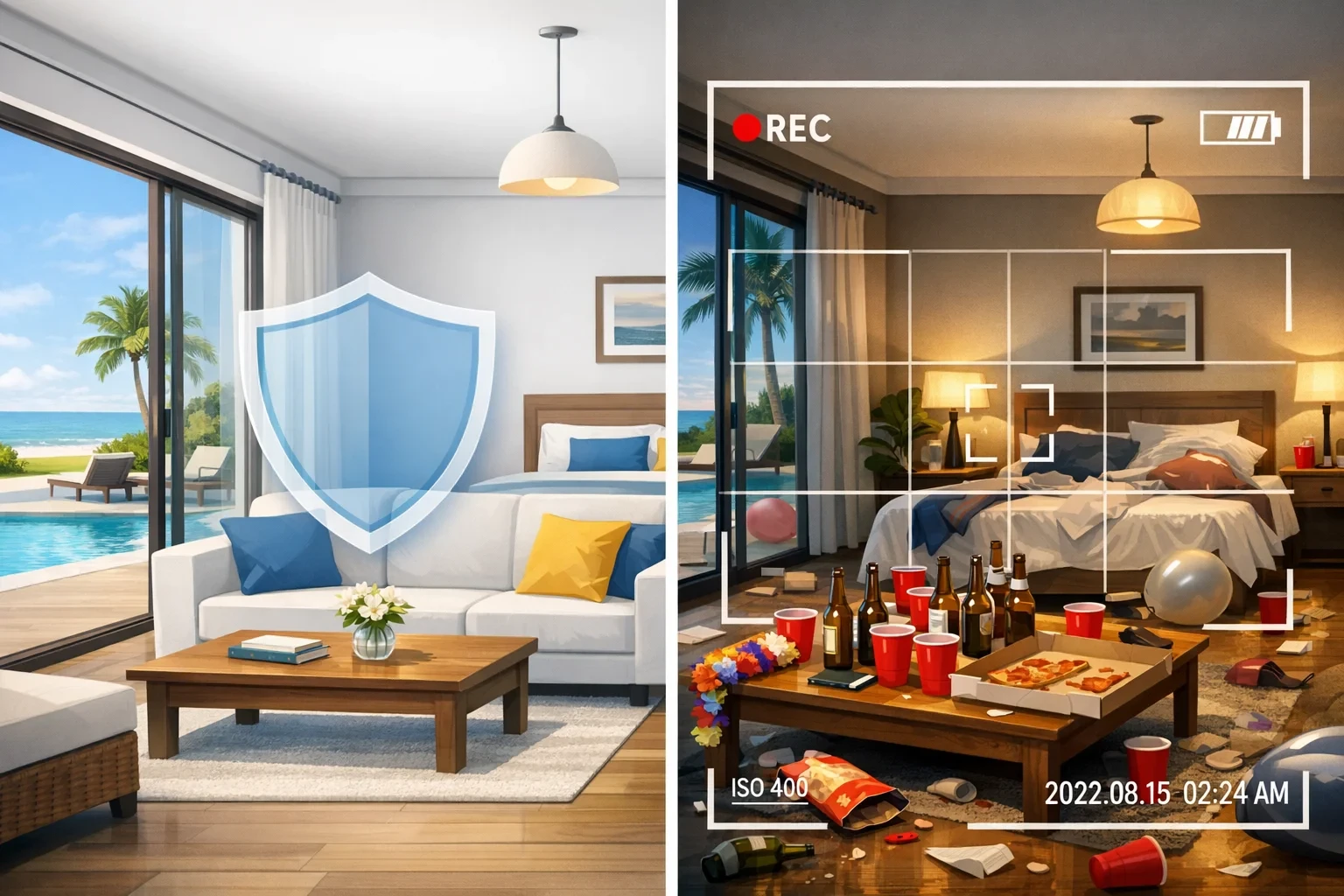
Finding out someone threw a party at your rental is one of the worst feelings in property management. Broken furniture, stained carpets, noise complaints from neighbors, maybe even police involvement. It's expensive, stressful, and makes you question whether this whole business is worth it.
Here's the thing though. You can prevent most parties. And when they do happen, you can recover your losses if you handle it right. Let me walk you through both sides.
Airbnb's Party Ban Actually Works
Some good news first. Airbnb made their party ban permanent in June 2022, and the numbers show it's working. According to Airbnb, party reports have dropped over 50% since 2020. In 2024, fewer than 0.06% of US reservations resulted in a party report.
Their anti-party tech blocks high-risk bookings automatically. Over Memorial Day and July 4th 2024, it deterred around 51,000 people from booking entire homes in the US. That's a lot of parties that never happened.
But 0.06% across millions of bookings is still a lot of incidents. And you really don't want to be one of them.
Prevention: Monitoring Tech That Actually Helps
The best party defense combines guest screening with real-time monitoring. Here's what's available.
Noise Monitoring
These devices measure decibel levels without recording conversations, which keeps them compliant with both Airbnb and Vrbo policies. You set thresholds and get alerts when things get loud.
Popular options:
Device | Pricing | Notes |
|---|---|---|
Minut | Also tracks occupancy via device detection | |
NoiseAware | Contact for pricing | Claims data from 5 million+ reservations |
Party Squasher | Focuses on occupancy detection |
Minut's crowd detection feature counts wireless devices nearby and alerts you when it exceeds your threshold. Worth noting: their system currently only detects iOS devices reliably since Android phones don't broadcast constantly. Still useful, but not foolproof.
Guest Screening
Screening services verify identity and check backgrounds before guests book. Some options:
Autohost: FCRA-compliant background checks, results in 10-15 minutes, usage-based pricing starting around $0.35-1.25 per verification
Safely: Checks criminal databases, sex offender registries, even Interpol. Starts at $5 per screening
Truvi (formerly Superhog): Combines screening with damage protection up to $5 million
No screening is perfect. But someone planning a rager is less likely to submit their ID for a background check.
House Rules That Matter
Be explicit in your listing:
No parties or events
Maximum occupancy (and that you monitor it)
Quiet hours
Consequences for violations
Airbnb's Community Disturbance Policy bans "disruptive gatherings regardless of size." Reference this in your rules.
When a Party Happens: First 24 Hours
You just got an alert or a neighbor called. Here's what to do.
1. Document immediately
This is the most important step and where most managers mess up. Take photos and videos of everything before you clean anything. Timestamps matter. Get shots of:
All damage (scratches, stains, broken items)
Trash and debris
Evidence of overcrowding
Anything that shows the scale of what happened
2. Contact the guest
Sometimes it's a misunderstanding. Usually it's not. Either way, having the conversation on platform messaging creates a paper trail.
3. Get repair estimates
You'll need receipts and quotes for your claim. Start reaching out to contractors immediately, even if repairs aren't urgent.
Documentation: The Make-or-Break Factor
Here's the reality that nobody wants to hear: without solid before-and-after evidence, your claim is probably getting denied.
Platforms need proof that the guest caused the damage. If you can't show what the property looked like before checkout, they have no way to verify your claim isn't about pre-existing issues. The Guardian recently reported on a case where a guest alleged altered images in a damage claim. The dispute went back and forth until media got involved. That's the kind of mess you want to avoid.
This is honestly why we built RapidEye. We process turnover photos automatically, comparing every image against your baseline to catch new damage with timestamps. When a claim dispute happens, you have documented proof of the property's condition before and after the stay. No manual review needed. No he-said-she-said.
Whatever system you use, the point is the same: you need consistent visual documentation of every turnover, not just when something goes wrong.
Filing Your Claim: Platform-Specific Steps
Airbnb
Airbnb's Host Damage Protection covers up to $3 million for guest-caused damage. Here's the process:
Submit your claim through the Resolution Center within 14 days of checkout
Include photos, videos, and repair estimates/receipts
Guest has 24 hours to respond
If they decline or don't respond, escalate for Airbnb review
Important: Host Damage Protection isn't insurance. It's a protection program with specific exclusions like normal wear and tear and "mysterious disappearance." And Airbnb can only charge a guest's payment method up to $500 automatically. Anything above that requires more steps.
Vrbo
Vrbo gives you 14 days after checkout to file a damage deposit claim. They'll cover valid claims up to your deposit amount even if they can't collect from the guest.
Their Accidental Damage Protection (through Generali) offers coverage from $1,500 to $5,000 for $59-119. But note the word "accidental." Intentional party destruction might not qualify.
When Platform Claims Fail
Sometimes platforms deny claims or the damage exceeds what they'll cover. Your options:
STR-specific insurance
Standard homeowners policies often exclude business activity, which includes short-term rentals. Dedicated STR insurance runs around $2,000-3,000 per year on average. Worth it if you're managing multiple properties.
Small claims court
If you have the guest's information and solid documentation, small claims is an option. Limits vary by state. California recently raised theirs to $12,500 for individuals. Nolo maintains a 50-state chart of current limits.
Is it worth the hassle? Depends on the damage amount and how strong your evidence is.
The Bottom Line
Party damage is scary but manageable. Stack your defenses: screening, monitoring tech, clear rules. When something happens anyway, document obsessively and file claims within the deadline.
The managers who handle this well aren't the ones who never have parties. They're the ones who can prove exactly what happened and when.
Finding out someone threw a party at your rental is one of the worst feelings in property management. Broken furniture, stained carpets, noise complaints from neighbors, maybe even police involvement. It's expensive, stressful, and makes you question whether this whole business is worth it.
Here's the thing though. You can prevent most parties. And when they do happen, you can recover your losses if you handle it right. Let me walk you through both sides.
Airbnb's Party Ban Actually Works
Some good news first. Airbnb made their party ban permanent in June 2022, and the numbers show it's working. According to Airbnb, party reports have dropped over 50% since 2020. In 2024, fewer than 0.06% of US reservations resulted in a party report.
Their anti-party tech blocks high-risk bookings automatically. Over Memorial Day and July 4th 2024, it deterred around 51,000 people from booking entire homes in the US. That's a lot of parties that never happened.
But 0.06% across millions of bookings is still a lot of incidents. And you really don't want to be one of them.
Prevention: Monitoring Tech That Actually Helps
The best party defense combines guest screening with real-time monitoring. Here's what's available.
Noise Monitoring
These devices measure decibel levels without recording conversations, which keeps them compliant with both Airbnb and Vrbo policies. You set thresholds and get alerts when things get loud.
Popular options:
Device | Pricing | Notes |
|---|---|---|
Minut | Also tracks occupancy via device detection | |
NoiseAware | Contact for pricing | Claims data from 5 million+ reservations |
Party Squasher | Focuses on occupancy detection |
Minut's crowd detection feature counts wireless devices nearby and alerts you when it exceeds your threshold. Worth noting: their system currently only detects iOS devices reliably since Android phones don't broadcast constantly. Still useful, but not foolproof.
Guest Screening
Screening services verify identity and check backgrounds before guests book. Some options:
Autohost: FCRA-compliant background checks, results in 10-15 minutes, usage-based pricing starting around $0.35-1.25 per verification
Safely: Checks criminal databases, sex offender registries, even Interpol. Starts at $5 per screening
Truvi (formerly Superhog): Combines screening with damage protection up to $5 million
No screening is perfect. But someone planning a rager is less likely to submit their ID for a background check.
House Rules That Matter
Be explicit in your listing:
No parties or events
Maximum occupancy (and that you monitor it)
Quiet hours
Consequences for violations
Airbnb's Community Disturbance Policy bans "disruptive gatherings regardless of size." Reference this in your rules.
When a Party Happens: First 24 Hours
You just got an alert or a neighbor called. Here's what to do.
1. Document immediately
This is the most important step and where most managers mess up. Take photos and videos of everything before you clean anything. Timestamps matter. Get shots of:
All damage (scratches, stains, broken items)
Trash and debris
Evidence of overcrowding
Anything that shows the scale of what happened
2. Contact the guest
Sometimes it's a misunderstanding. Usually it's not. Either way, having the conversation on platform messaging creates a paper trail.
3. Get repair estimates
You'll need receipts and quotes for your claim. Start reaching out to contractors immediately, even if repairs aren't urgent.
Documentation: The Make-or-Break Factor
Here's the reality that nobody wants to hear: without solid before-and-after evidence, your claim is probably getting denied.
Platforms need proof that the guest caused the damage. If you can't show what the property looked like before checkout, they have no way to verify your claim isn't about pre-existing issues. The Guardian recently reported on a case where a guest alleged altered images in a damage claim. The dispute went back and forth until media got involved. That's the kind of mess you want to avoid.
This is honestly why we built RapidEye. We process turnover photos automatically, comparing every image against your baseline to catch new damage with timestamps. When a claim dispute happens, you have documented proof of the property's condition before and after the stay. No manual review needed. No he-said-she-said.
Whatever system you use, the point is the same: you need consistent visual documentation of every turnover, not just when something goes wrong.
Filing Your Claim: Platform-Specific Steps
Airbnb
Airbnb's Host Damage Protection covers up to $3 million for guest-caused damage. Here's the process:
Submit your claim through the Resolution Center within 14 days of checkout
Include photos, videos, and repair estimates/receipts
Guest has 24 hours to respond
If they decline or don't respond, escalate for Airbnb review
Important: Host Damage Protection isn't insurance. It's a protection program with specific exclusions like normal wear and tear and "mysterious disappearance." And Airbnb can only charge a guest's payment method up to $500 automatically. Anything above that requires more steps.
Vrbo
Vrbo gives you 14 days after checkout to file a damage deposit claim. They'll cover valid claims up to your deposit amount even if they can't collect from the guest.
Their Accidental Damage Protection (through Generali) offers coverage from $1,500 to $5,000 for $59-119. But note the word "accidental." Intentional party destruction might not qualify.
When Platform Claims Fail
Sometimes platforms deny claims or the damage exceeds what they'll cover. Your options:
STR-specific insurance
Standard homeowners policies often exclude business activity, which includes short-term rentals. Dedicated STR insurance runs around $2,000-3,000 per year on average. Worth it if you're managing multiple properties.
Small claims court
If you have the guest's information and solid documentation, small claims is an option. Limits vary by state. California recently raised theirs to $12,500 for individuals. Nolo maintains a 50-state chart of current limits.
Is it worth the hassle? Depends on the damage amount and how strong your evidence is.
The Bottom Line
Party damage is scary but manageable. Stack your defenses: screening, monitoring tech, clear rules. When something happens anyway, document obsessively and file claims within the deadline.
The managers who handle this well aren't the ones who never have parties. They're the ones who can prove exactly what happened and when.